
Criminal Cases in the Lafayette County Courts
The Wisconsin Circuit Court is the state's general-jurisdiction trial court. Lafayette County has one circuit branch. That Lafayette County branch hears felony, misdemeanor, and criminal traffic prosecutions filed here. There is no separate Lafayette County misdemeanor court. The case number often signals the category: CF marks a felony case, CM a misdemeanor, and CT criminal traffic. A number is a filing key, not a statement about guilt.
The Lafayette County Clerk of Courts is custodian of the filed case record. The Lafayette County clerk maintains pleadings, orders, judgment entries, and the court's event history. Municipal ordinance cases occupy a different lane. A city citation may remain with a municipal or city channel because an ordinance forfeiture is not a state criminal prosecution. Checking the issuing authority and Lafayette County case code prevents a fruitless search in the wrong system.
Lafayette Court Routes by Case Type
The practical split is between the Lafayette County Circuit Court and a municipal citation channel. State-law crimes go to the Lafayette County circuit branch after the district attorney files a complaint. City ordinance matters may be handled by the issuing municipality. The official Darlington, Cuba City, and Shullsburg sites did not yield a shared Lafayette County municipal portal during research, so the citation itself is the best first routing clue.
| Record sought | Starting point | Why |
|---|---|---|
| Felony or misdemeanor case | WCCA, then Lafayette Clerk | The circuit court holds the filed prosecution. |
| Criminal traffic case | WCCA with CT code | The statewide index covers public circuit filings. |
| Municipal ordinance citation | Issuing city or citation contact | It may not be a Lafayette County criminal case. |
| Appeal | Wisconsin Court of Appeals, District IV | District IV hears appeals from Lafayette County. |
This Lafayette County routing also explains why a search can be accurate yet incomplete for the question asked. A police contact that never became a filed charge will not create a Lafayette County circuit criminal case. Conversely, a filed Lafayette County docket does not contain every piece of the police investigation.
How to Search Case Records
Wisconsin Circuit Court Access, commonly called WCCA or CCAP, is the free statewide index for public circuit cases. It does not require an account for an ordinary public search. Accept the terms before entering criteria, and expect a human-verification step. A Lafayette County case number is the cleanest route. When only a name is known, add reliable identifiers and set the county filter to Lafayette County.
- Open WCCA, read the terms, and choose person-name or case-number search.
- Enter the full legal name. Add a birth date when it is known and appropriate.
- Select Lafayette County, or enter the exact case number from a citation or notice.
- Open the case detail and read every count, plea, disposition, and dated docket event.
- Ask the Lafayette County Clerk for the complaint, judgment, transcript, or certified copy that WCCA does not provide.
| Field label | Type | Required | Use |
|---|---|---|---|
| Last name | Text | Yes for name search | Run spelling variants separately. |
| First and middle name | Text | Optional | Narrows a common surname. |
| Birth date | Date/text | Optional | Helps separate people with similar names. |
| County | Dropdown | Optional | Select Lafayette for local filings. |
| Case number | Text | Yes in number mode | Uses year, case code, and sequence. |
| Captcha | Challenge | When shown | Limits automated or bulk searches. |
Inside Lafayette County WCCA Results
The official WCCA search is the best remote view of a public Lafayette County docket. The captured interface shows why the county filter and exact-name fields matter.
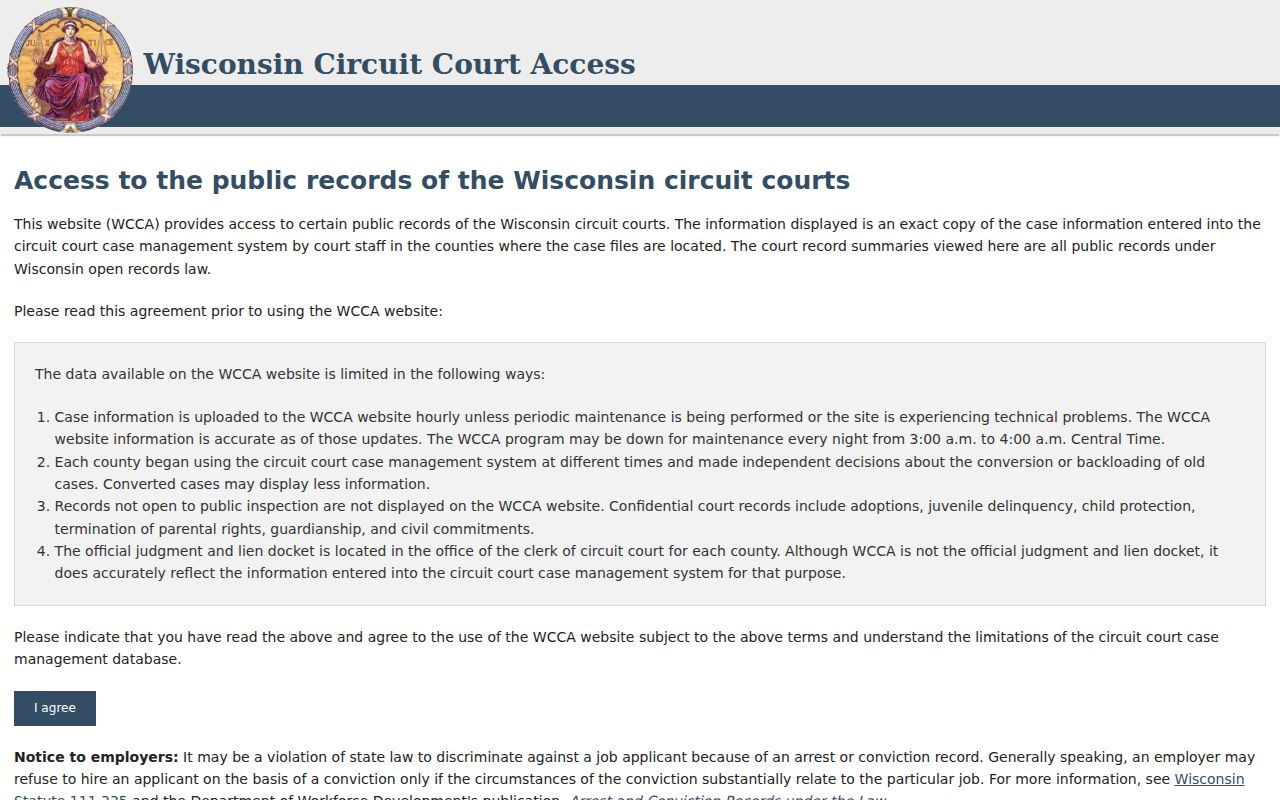
WCCA can show the Lafayette County caption, filing date, case status, branch, parties, charges, hearing dates, docket events, judgment data, and public financial entries. It can also reveal an amended or dismissed Lafayette County count alongside a count that ended in conviction. Read Lafayette County charge rows one at a time. The first allegation is not always the last charge, and the status of one count does not settle every other count.
The index does not display or sell Lafayette County filed documents. A Lafayette County docket line may say that a complaint, motion, or judgment was filed without offering the PDF. Current custody can also change faster than a court event. For those questions, use the Lafayette County clerk or jail rather than guessing from a short WCCA event label.
What the Case File Shows
A Lafayette County criminal case file records what the prosecutor alleged and what the court did. The Lafayette County docket is its timeline, while the complaint and later orders supply detail. A useful Lafayette County review moves from the case header to each charge, then through events and the final judgment. That order helps distinguish a pending allegation from a resolved charge.
| Case Number & Court | County, case code, filing sequence, branch, judge, filing date, and status. |
|---|---|
| Charging Document | The complaint or information states filed offenses and supporting allegations. |
| Charges | Count, statute, description, class, offense date, plea, disposition, and disposition date. |
| Docket Entries | Dated filings, hearings, orders, warrants, pleas, motions, and post-judgment activity. |
| Hearing Dates | Scheduled or completed event, location, court official, and result when entered. |
| Disposition & Judgment | Dismissal, acquittal, guilty or no-contest judgment, with count-level outcomes. |
| Sentence & Conditions | Confinement, probation, extended supervision, fines, costs, restitution, and time-served entries when public. |
| Documents | Descriptions appear online, but copies and transcripts come from the Clerk of Courts. |
Victim and citizen-witness names are not entered into Lafayette County public-display fields. Social Security numbers, payment-security data, passwords, and juror addresses also stay outside the public view. Lafayette County juvenile, expunged, sealed, or otherwise confidential records may be absent or limited.
Reading Lafayette Criminal Case Codes
Short terms carry a lot of weight on a Lafayette County docket. The Lafayette County case-type code identifies the filing lane. Event words tell what occurred, but not always why. A dismissal means that count did not produce a Lafayette County conviction in that case. It does not by itself state factual innocence or explain whether another count resolved through a plea.
- CF
- A criminal felony case in Wisconsin Circuit Court.
- CM
- A criminal misdemeanor case in Wisconsin Circuit Court.
- CT
- A criminal traffic case, distinct from a simple civil traffic matter.
- Disposition
- The outcome recorded for a charge, such as dismissal, acquittal, or conviction.
- No contest
- A plea that generally produces a conviction without a formal admission for every other purpose.
- Signature bond
- Release based on a signed promise and conditions rather than cash paid up front.
“Deferred prosecution agreement” means a Lafayette County prosecution is held under agreed terms. Later Lafayette County entries must be read to learn whether the agreement was completed. A warrant event also needs context. The Lafayette County sheriff or court should confirm current status because a historic warrant line can remain in the event history after later action.
Stages of a Criminal Case
A Lafayette County prosecution begins only if the district attorney files charges. The Lafayette County court then holds an initial appearance, addresses rights and release terms, and sets the next event. A Lafayette County felony can include a preliminary examination, information, and arraignment. Lafayette County misdemeanors skip the felony preliminary-hearing stage. Discovery, motions, competency issues, and plea talks may fill the pretrial period.
Case flow: Charges Filed › Arraignment › Pretrial › Plea or Trial › Disposition › Sentencing
A Lafayette County case may end through dismissal, plea, trial verdict, or another lawful disposition. Lafayette County sentencing follows a conviction. Appeals from Lafayette County move to District IV of the Wisconsin Court of Appeals. The Lafayette County docket should be read through its newest entry because an early charge or hearing note rarely tells the complete outcome.
Why Lafayette Court Charges Change
A Lafayette County booking charge records the reason presented at jail intake. A filed Lafayette County charge reflects the prosecutor's decision after reviewing the referral. The Lafayette County court judgment records the count that survived dismissal, amendment, plea, or trial. Those three labels can differ without any database being wrong.
For that reason, do not copy the first Lafayette County charge line and stop. Compare the incident date, complaint, amended counts, plea, disposition date, and judgment. The broader Lafayette County arrest history explains the separate police and booking trail, while the Lafayette County court file supplies the formal prosecution and result. If a name-only WCCA hit is uncertain, confirm identity before linking it to a person.
Note: An arrest or filed complaint is an accusation, and neither one proves a criminal conviction.
Access & Restrictions
Wisconsin begins with a strong policy favoring public access under Wis. Stat. § 19.31. That policy does not turn all Lafayette County court data into open web data. Lafayette County juvenile matters are governed by Wis. Stat. § 938.396. Protected identifiers, victim information, sealed material, and expunged records may be withheld or removed from Lafayette County public display.
When no Lafayette County case appears, check spelling, county, case type, and filing time. A very recent Lafayette County police event may not yet have a case. An older Lafayette County file may require archive retrieval. Courthouse WCCA terminals are available statewide for people without internet access, but counter hours should be confirmed before travel. Ask the clerk whether the file is on site, archived, or subject to a court order. Requesters seeking inspection or copies should provide the Lafayette County case number and exact item, then ask about page, certification, postage, search, and retrieval costs before ordering. No fixed Lafayette County copy total was located in the official research.
Missing Lafayette Court Documents
A missing WCCA document link is normal because the public index does not provide Lafayette County case PDFs or transcripts. Write down the Lafayette County case number, docket date, and exact event description. Then contact the Lafayette County Clerk of Courts at 608-776-4835 or visit 626 Main Street, Darlington, WI 53530. State whether a plain Lafayette County copy, certified copy, transcript, or inspection is needed.
Lafayette County Clerk of Courts
626 Main Street
Darlington, WI 53530
608-776-4835
Criminal and traffic files, judgments, copies, certification, and counter access.
For an older Lafayette County matter, ask whether staff need lead time to retrieve an archive or microfilmed file. If Lafayette County access is denied or limited, ask which statute, rule, or order applies and whether a court request is available. The Lafayette County clerk can explain record access, but cannot give legal advice or rewrite a police report.
Expunged Lafayette Court Records
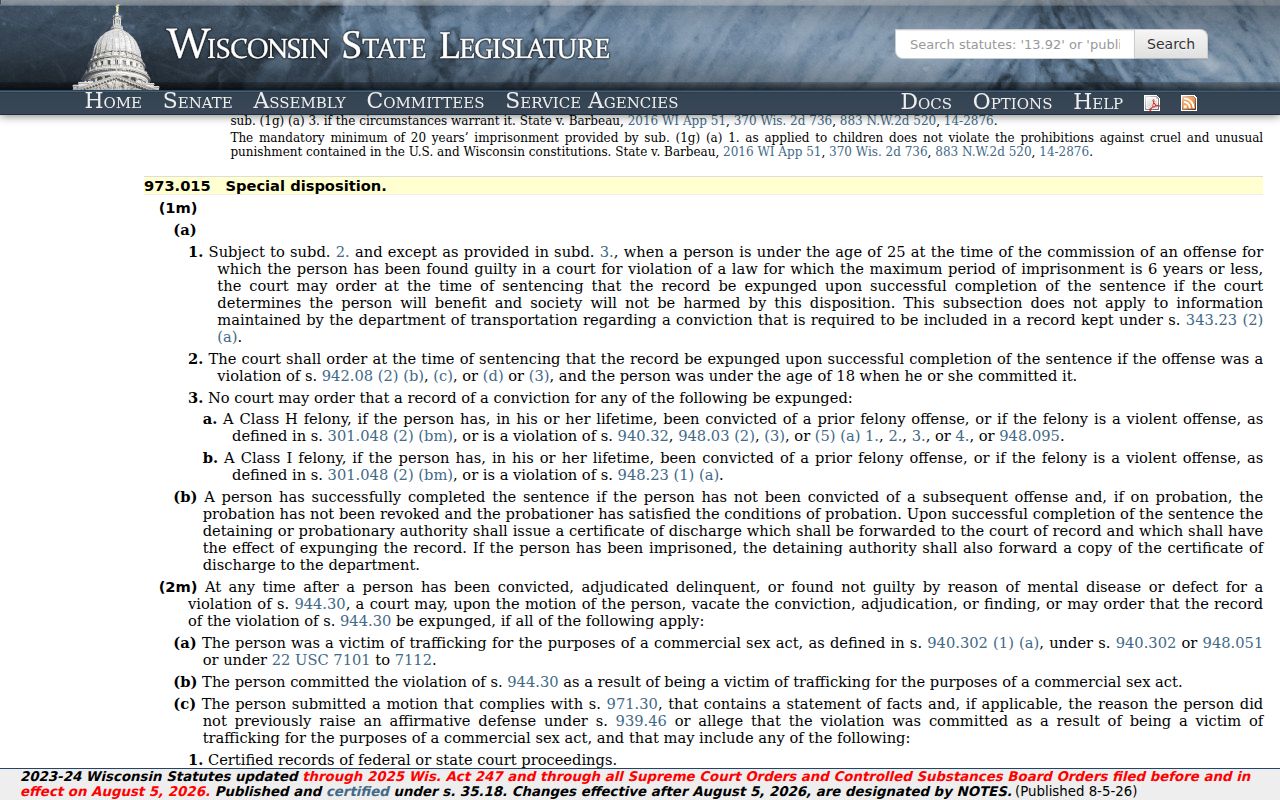
Wisconsin expungement under Wis. Stat. § 973.015 is narrow. Lafayette County eligibility generally must be decided at sentencing, statutory conditions must be met, and the sentence must be completed successfully. It is not a broad later-filed process for any old conviction. An expunged Lafayette County court record is removed from public court view, but that result does not automatically erase every independent police or executive-agency file.
The official Wisconsin expungement statute defines the remedy that can change public access to a Lafayette County criminal case.
After a Lafayette County order, check WCCA and the Wisconsin DOJ repository separately. The Lafayette County court clerk controls the court record, while the Crime Information Bureau controls the state criminal-history response. A Lafayette County correction may therefore require contact with more than one custodian.